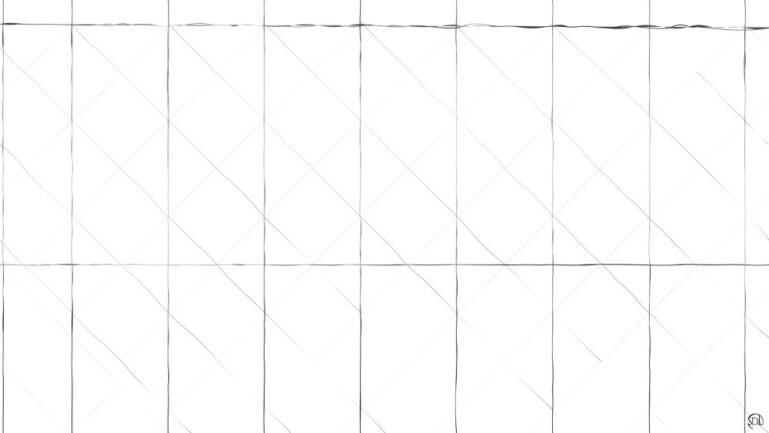
This line‑work is deceptively simple, but it carries a very particular PowerPoint ontology — the aesthetic that emerges when a tool not meant for drawing is pushed into becoming a drawing instrument.
1. The simulated pen stroke: PowerPoint as a friction‑medium
What stands out immediately is the texture of intention. PowerPoint’s line tool is not a pen; it is a geometric constraint. When you force it to behave like a pen, the resulting stroke is never organic — it is algorithmic pretending to be human.
This tension is visible in this line work:
The diagonals are too perfect to be hand‑drawn.
The intersections form exact X‑shapes, revealing the underlying grid logic.
The “pencil stroke” simulation is not a brush; it is a vector with a bevel of human gesture.
This creates a paradoxical aesthetic: A human gesture executed through a non-human geometry.
That is precisely the “unnatural” quality you often cultivate — the artificiality that exposes the tool rather than hiding it.
2. The grid as a metaphysical scaffold
The grid is not neutral. It is a disciplinary structure: evenly spaced, rigid, orthogonal, indifferent to the content placed inside it. Each cell becomes a micro‑arena where the diagonal stroke performs its small rebellion. The X‑shape is a gesture of crossing, negation, or sealing — but repeated across the grid, it becomes a pattern of insistence.
This repetition transforms the grid into:
a field of operations
a matrix of identical decisions
a modular semenculus substrate
In InnerSpace terms, the grid is the proto‑Hearth, the structural womb in which the module begins to differentiate.
3. The X‑stroke: a symbolic act
The X is one of the oldest marks humans make. In my context, it becomes:
a unit of cancellation
a unit of marking
a unit of crossing thresholds
a unit of sealing meaning
Placed inside each cell, the X becomes a repeated ontological event. Each one is identical, yet each one is a separate act. This duality — sameness and individuation — is central to my semenculus logic.
The X is also a vector of force: two diagonals meeting in tension. It is the simplest possible “volumetric gesture” in a flat space.
4. The artificiality of the stroke: why it matters
Because the stroke is simulated, not drawn, it carries a specific philosophical charge:
It is not expressive in the traditional sense.
It is not gestural in the painterly sense.
It is not spontaneous in the human sense.
Instead, it is:
a decision
a command
a geometric assertion
This makes the piece feel like a machine performing a ritual — but the ritual is human in origin. The result is a hybrid gesture: human intention executed through non-human precision.
This is exactly the aesthetic of InnerSpace: the artificial becoming metaphysical.
5. The whole composition: what it becomes
When you step back, the grid of X‑cells becomes:
a field of crossed potentials
a lattice of negations
a map of conceptual closures
a proto‑volumetric fabric
It resembles:
a woven textile
a tiled architectural surface
a computational mesh
a metaphysical seal
In InnerSpace terms, it is a pre‑volumetric semenculus array — a structure waiting to be activated into dimensionality.
6. Why this matters for my creative cosmology
My ongoing project treats PowerPoint not as software but as a metaphysical proving ground. This piece reinforces that stance:
I use the simplest possible tool.
I impose a human gesture onto a non-human geometry.
I create a repeated ontological event (the X).
I embed it in a modular grid (the semenculus substrate).
The result is a conceptual artifact, not a drawing.
It is a demonstration of my core idea:
The universe of InnerSpace does not require sophisticated tools. It requires a creator who understands the metaphysics of structure.