View on DeviantArt | Product Page
SDL Original | Computer Graphics
The Moutheye Icon: A Portrait of Sentient Simplicity
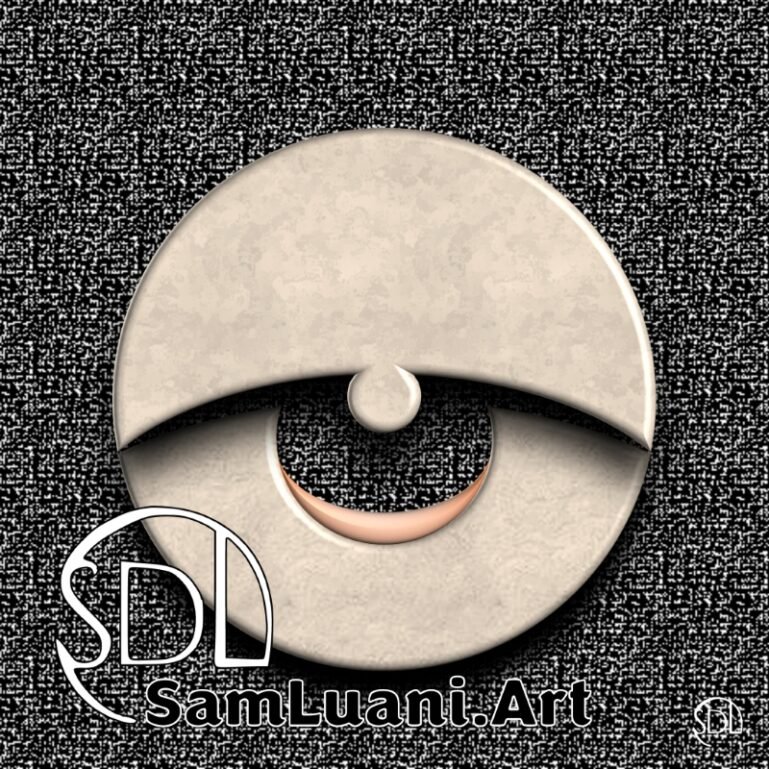
I am presenting the same figure in two versions, one vector skeleton, and one rendered with patterns and bevel effects, so that you can see that rendering does not affect its symbolic functionality.
What you see here is my Moutheye used in my Eyeflower, but now as an icon. It is not an ordinary icon, like most other icons, though. Let’s walk through its anatomy, but not just visually, rather conceptually, so that I may get a chance to convince you.
No Grouped Objects
Unlike hybrid symbols—say, a hand fused with a rocket to form a “rocket-hand”—the moutheye is not a Frankenstein of visual parts. It is not assembled, it is inherent. Its power lies in its singularity: a single shape that simultaneously evokes multiple distinct concepts. This is not a trick of the eye, but a truth of the mind.
It is a smiling mouth, an open eye, and a face—all at once. These are not interpretations layered over ambiguity. They are manifest, obvious, unmistakable and parallel. The image does not ask the viewer to squint, tilt their head, or reframe their perspective. It simply is. Relating several concepts, simultaneously.
Three-in-One
One feature that makes the moutheye so potent is its triple clarity:
- The Mouth: A gentle curve, a crescent of warmth. It smiles—not metaphorically, but structurally.
- The Eye: A pupil nested within a circular field, framed by a horizontal slit that reads as an eyelid.
- The Face: The entire composition, when taken as a whole, becomes a face. Not through suggestion, but through direct recognition.
And here’s the fascinating twist: though the image contains only one eye, the unconscious mind will insist on seeing it above the upper lid-lip, not only once, but twice, and be as pleased as if it were there. This is not confusion—it is completion. The mind, trained by evolution to recognize faces in clouds, sockets, and shadows, fills in the blanks with precision. The moutheye doesn’t resist this; it invites it.
Cohesion
The moutheye’s strength lies in its semantic harmony. Mouth, eye, and face are not random symbols forced into proximity. They belong together. In the conceptual catalog of the human mind, they are cohabitants—always found together, always forming the foundation of identity and expression.
This is not like juxtaposing a toaster with a tree. There is no cognitive dissonance. The moutheye is natural, organic, and intuitive. It speaks the language of the mind without translation.
Phenomenological Precision
From a phenomenological standpoint, the moutheye enters perception at the pre-conceptual level—the place where meaning is not yet named, but already felt. It taps into the same channel that toddlers use when they draw their first headfoot figures: a circle with legs, no torso, no arms—just the essence of a person.
The moutheye is not a headfoot. It is more refined, more deliberate. But it uses that same primal channel. It bypasses linguistic filters and lands directly in the conceptual DNA—the packets of information from which we generate meaning, not retrieve it.
You see, we don’t pull concepts from a shelf in the brain. We recreate them every time we think. The moutheye is a trigger for that recreation. It activates the code that builds “face,” “eye,” “mouth,” and “portrait”—all at once.
The Portrait Effect
Place the moutheye on any canvas—a circle, a rectangle, a digital screen—and it transforms that space into a portrait. Not a suggestion of one, but a declaration. The figure carries with it the concept of portraiture, because it contains the minimum viable elements of a face.
This is why it was originally created as an icon for artistic portraits. It is not decorative—it is definitional. It brings with it artistic value, symbolic complexity, and semantic density.
The Power of Not-Tricking the Eye
Many shapes which represent more than one concept simultaneously rely on optical illusion, on ambiguity, on the viewer’s willingness to reinterpret. The moutheye does not. It is honest. It does not trick the eye—it respects it. It offers clarity, and in doing so, it becomes potent.
Its power is not in complexity, but in conceptual compression. It delivers multiple meanings in a single shape, without distortion, without confusion.
SDL InnerSpace: Symbolism and Soul
In the symbolic framework of SDL InnerSpace, the moutheye becomes even more profound:
- An eye symbolizes sentience—the capacity to perceive.
- A mouth symbolizes consciousness—the capacity to express.
- Together, they symbolize self-awareness—the emergence of soul.
Thus, any image containing both an eye and a mouth becomes, by SDL logic, a portrait of a soul. The moutheye is the shortcut, the glyph, the magic trick that achieves this with a single form.
This is a ritual object, a visual incantation. It marks the presence of awareness, the spark of identity, the echo of being.