SDL Original | Collection
ID | SDL2025G2C4
Title | Bass Clef Nightingale Choir
A visual study of polyphonic magic, by Sam Diellor Luani
Browse Products | Browse Stories
What is presented here as a systematic study—unfolding in acts, chapters, and plates—is, in truth, a curated reconstruction designed for the archives of SDL InnerSpace. While it wears the mask of academic inquiry, this work is a “pastiche of a study.” It mimics the rigor of science to reveal the chaos of art.
Introduction
Between the Flash and the Archive
The genesis of this work was not a labored intellectual pursuit, but a flash of intuition—a spark from the old land of my childhood. The realization of the Bass Clef’s potential occurred not in a studio, but in the ephemeral curiosity of a child learning to read notes and play the mandolin. To the adult eye, the clef is a directive for pitch; to the child’s eye, it was a tiny creature, curled and waiting.
The first physical assembly of these images occurred in the late 1990s. It was not a month-long dissertation, but a “fever hour”—a moment of joyous, drill-like experimentation where decades of peripheral vision suddenly snapped into focus. I exhausted quite a few combinations in a matter of hours because the shapes had been living in my subconscious for years.
Yet, this remains a study in the truest artistic sense. In the philosophy of SDL InnerSpace, an “Origins” story is rarely linear. It is a spiral. An artistic study does not require footnotes; it requires the relentless visual interrogation of a shape. With this work, I am giving a formal face to those fleeting childhood experiments, integrating them into the tangible history of InnerSpace. I am fossilizing a flash of insight so that it may be examined.
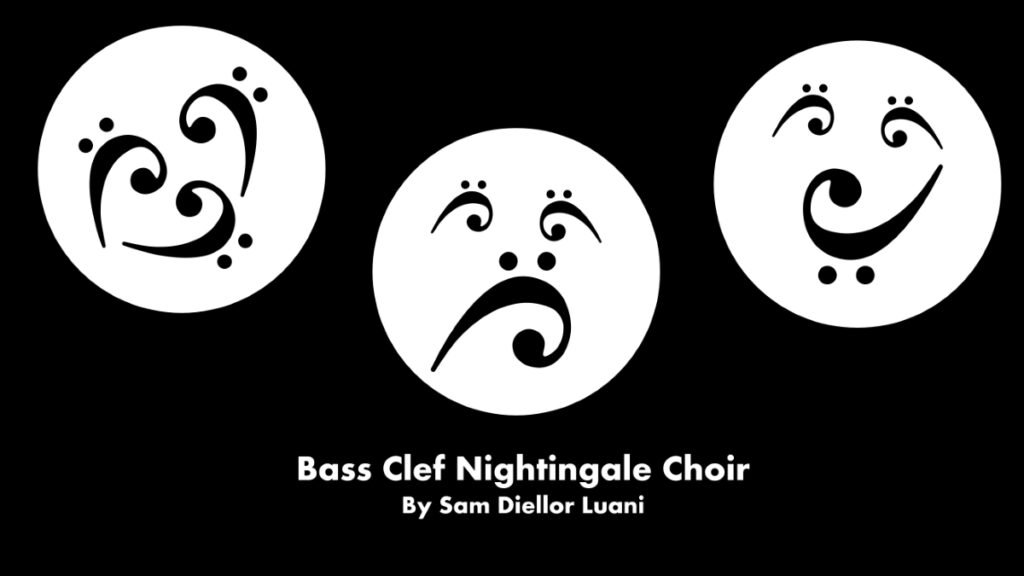
A Visual Pastiche of Polyphonic Singing
At its surface, this study serves as a rigorous exercise in modular painting and complex tiling. It is an exploration of the “Atomic Theory” of design: how a single, indivisible element can create a universe of complexity.
It acts as an inter-mediatic pastiche of music, yet it refuses the common trap of kitsch. We are not using the Bass Clef to create a lazy, decorative association with melody. Instead, we are engaging in a visual simulation of choir singing.
In the lexicon of this study, every individual Bass Clef acts as a distinct voice. When isolated, it is a solo—lonely, distinct, and finite. But when these modules are tiled—when the curves interlock, the “dots” align as eyes, and the tails intertwine as limbs—they function like voices in a polyphonic choir.
The resulting image—the inevitable face or creature that emerges from the cluster—is the visual equivalent of a harmonic chord. It is a “Gesamtkunstwerk” (a total artwork) created by the consensus of its parts. This is not a symbol of music; it is a shape behaving like music. It mirrors the very structure of SDL InnerSpace: a collection of fragmented concepts and memories singing together to form a coherent identity.
A Visual Pastiche of Magic & Sigil-Craft
In its second dimension, this series descends into the esoteric. It functions as a visual pastiche of the magical arts, specifically the ancient traditions of Binding and Labyrinthine Magic.
In the domains of the occult, a shape is never merely aesthetic; it is a container. The methodology used here—knitting, rotating, and tiling the Bass Clef—mirrors the ritualistic practice of creating “spirit traps” found in Babylonian and Medieval magic. In those traditions, lines were knotted until they formed a complex geometry capable of “catching” a demon or a blessing.
By treating the Bass Clef not as a static sign but as a dynamic module, this work demonstrates the mechanism of Geometric Summoning. The individual clef is inert matter. But when knitted together along specific vectors, it creates a “visual interference pattern.” It is within this pattern that the “creature” manifests.
We do not draw the faces that appear in these compositions. We summon them. They are the inevitable result of the geometry “locking” into place. This aligns with the mythopoetry of my art: the belief that the image already exists in the white void of the paper, waiting only for the right structural incantation to reveal it. The Bass Clef is the sigil; the tiling is the ritual; the image is the ghost forced to reveal itself.
A Meta-Illustration of Neural Emergence
In its third and perhaps most modern dimension, this series serves as an artistic meta-illustration of Neural Network theory. It visualizes the mysterious transition from “Data” to “Sentience,” bridging the biological curiosity of earlier works with the systemic nature of SDL VIEW.
In the language of Artificial Intelligence, a single neuron (or node) is a simple mathematical function—it takes an input, weighs it, and produces an output. A single node cannot “think.” However, when you tile thousands of these identical nodes into layers, a Phase Transition occurs. The quantity of connections produces the quality of Cognition.
This study performs that exact operation using analog ink:
- The Node: The single Bass Clef acts as the “Perceptron.” It has a head (input), a curve (processing/weight), and a tail (output). On its own, it is meaningless data.
- The Network: By tiling these clefs, we create a “layer” of complexity.
- The Emergence: Suddenly, without the artist adding a single new line, a Face appears.
This appearance of a “person” where there was only ink is a perfect analog for the “Ghost in the Machine.” The sentience is not inside the clef, just as consciousness is not inside the silicon chip. The soul is an emergent property of the Pattern.
This study challenges the viewer to witness the exact moment where “Matter” (the ink shape) wakes up and becomes “Mind” (the portrait). It is a manual simulation of the machine mind, proving that if you arrange the “Quintessence” of a shape correctly—be it in the code of an AI or the ink of SDL InnerSpace—the recognition of a soul is inevitable.
Table of Contents
Why Functional Symbols Become Kitsch
This article explains why functional symbols like letters or the treble clef become kitsch when removed from their context.
This article details the bass clef’s structure—its curved “Comma” body and two dots—and explores its expressive transformations when detached and rotated.
SDL2025G2C4102 | Bass Clef Down
Rotating the bass clef 90 degrees left reveals a psychologically charged figure exhibiting a “cluster of distress.”
Rotating 90 degrees right yields a contrasting image with an infantile, joyful character, interpreted as a “Happy Kid” with a gap-toothed smile and wheels, evoking innocence and playful motion.
By rotating the bass clef 135 degrees right, the symbol transforms into the “Poetic Nightingale,” a magical sign bridging solar and lunar symbolism.
SDL2025G2C4105 | Summoning Nightingale
This article presents a ritualistic plate showing four phases of the bass clef—standard, down, up, and nightingale—documenting the extraction of life and song from inert ink.
SDL2025G2C4132 | Our Common Nightingale
This artwork “Our Common Nightingale” uses the nightingale glyph as a compositional law, compressing and deforming the bird’s form akin to poetic meter.
SDL2025G2C4106 | Bass Clef Heart Frame
The bass clef heart, often misrepresented as a simple musical love symbol, here is revealed as a potent, volatile daemonculus embodying privacy and tension.
SDL2025G2C4107 | Bass Clef Angel Heart
This study plate shows how connecting the clefs by their dot-like heads transforms the defensive gatekeeper into a symbol of affection and love.
SDL2025G2C4108 | Bass Clef John Lennon
In its extension the study identifies a distinct portrait emerging when the two bass clefs forming the heart frame meet at their heads: John Lennon.
SDL2025G2C4109 | Bass Clef Nuclear Family
This image depicts a “nuclear” bass clef family, where a large bass clef represents the protective or controlling father, sheltering two smaller clefs as children forming the nucleus.
SDL2025G2C4131 | Treble Clef Kitsch
In contrast to the living glyph of the bass clef, here the treble clef is presented as an inert, kitschy symbol that loses meaning and vitality when removed from its musical context.
To be continued with new articles and plates. Previews available on DeviantArt.