A Memory of Home Away from Home
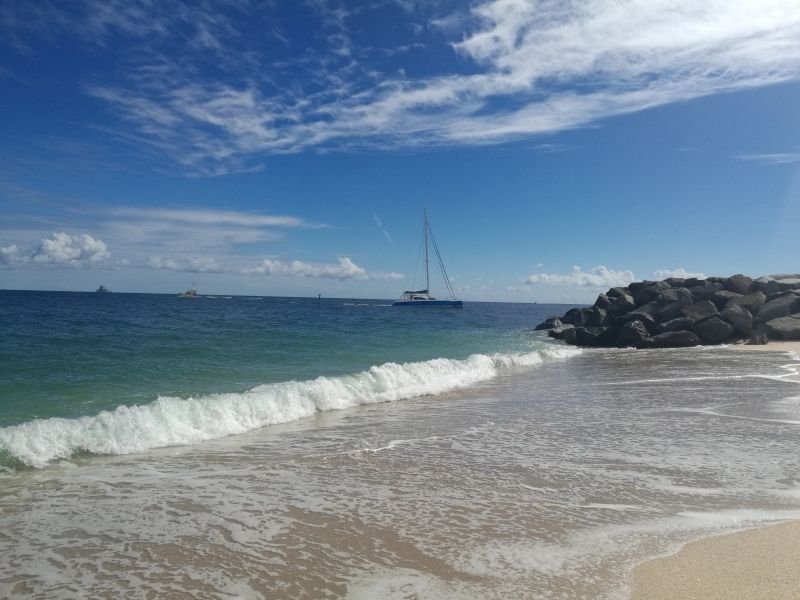
Nine years ago, on November 4th, 2016, I stood on the sands of West Palm Beach, Florida, and captured this image. The scene was simple: gentle waves rolling onto the shore, a sailboat anchored in the calm waters, and a rocky breakwater stretching into the horizon. The sky was clear, scattered with soft clouds, and the air carried that unmistakable salt-and-sun fragrance of the Atlantic coast. Yet behind this tranquil frame was a moment in history, and a deeply personal realization that would stay with me long after I left.
I had come to the United States during the final days of the presidential election campaign that year. The atmosphere was charged, intense, and unforgettable. I happened to be in Miami on the day of one of Donald Trump’s rallies, and later in Fort Lauderdale, where the energy of the campaign was palpable. For someone visiting from Europe, it was both an adventure and, in some ways, a shock. The United States was not just a country in transition—it was a stage where the world’s attention was fixed. To witness it firsthand was to feel history unfolding in real time.
But beyond the politics, what struck me most was something far more personal. From the very first days of my journey, I felt an uncanny sense of belonging. The United States did not feel like a foreign land. It felt like home. That may sound strange, but it was as if I had been living there my entire life, and had only stepped away for a short while. Walking the streets, speaking with people, tasting the food, and absorbing the culture—it all felt deeply familiar, almost second nature.
This was not an illusion. It was the recognition of a truth I had carried with me for years: that my life, like so many others around the world, had been shaped by American culture. From music and movies to literature, technology, and even the rhythms of everyday speech, the United States had been a constant presence in my upbringing. Standing on that Florida beach, I realized that Europe, which I had always thought of as the center of the world, was in fact just one edge of a much larger civilization. The true cultural empire of our age was America—the Rome of modern times.
That sense of belonging was reinforced in countless small encounters. In Florida, I would often find myself in conversation with locals. Inevitably, there would come a moment when I revealed that I was from Europe, just visiting. Almost without exception, people would pause, look at me in disbelief, and say, “No, come on, you must be joking…” It became a kind of game, a recurring moment of recognition that I was, in some way, blending seamlessly into the fabric of American life. My work in language services had made me something of a cultural chameleon, able to adapt dialects and mannerisms, but this was more than mimicry. It was a genuine resonance, a feeling of being at ease in a place that had always been part of me.
The photograph you see here is not just a picture of a beach. It is a symbol of that realization. The sailboat drifting on calm waters, the horizon stretching endlessly outward, the balance of nature and human presence—it all spoke to me of possibility, of journeys taken and journeys yet to come. It was a moment of peace in the midst of a turbulent time, a reminder that even as history surged around us, there were still places where one could breathe, reflect, and feel at home.
Looking back now, nine years later, I see that trip as a turning point. It was not only about discovering America, but about discovering myself in relation to it. I understood then why so many around the world feel a connection to the United States, even if they have never set foot there. It is not simply about politics or power—it is about culture, identity, and the shared experiences that bind us across oceans.
At the same time, I cannot ignore the paradox of this influence. While I was grateful for the sense of belonging, I also recognized the challenges it brings. In many countries, including my own, younger generations are growing up immersed in American media, often at the expense of their mother tongues and local traditions. It is a double-edged sword: the gift of connection, but also the risk of cultural erosion.
And yet, standing on that beach in West Palm, I chose to embrace the positive. I chose to see the United States not as a distant power, but as a place of welcome, a place that felt like home.
I took a swim that day, and these waves carried me into a new understanding, of the truth that home is not where you are born, but where you feel you belong.